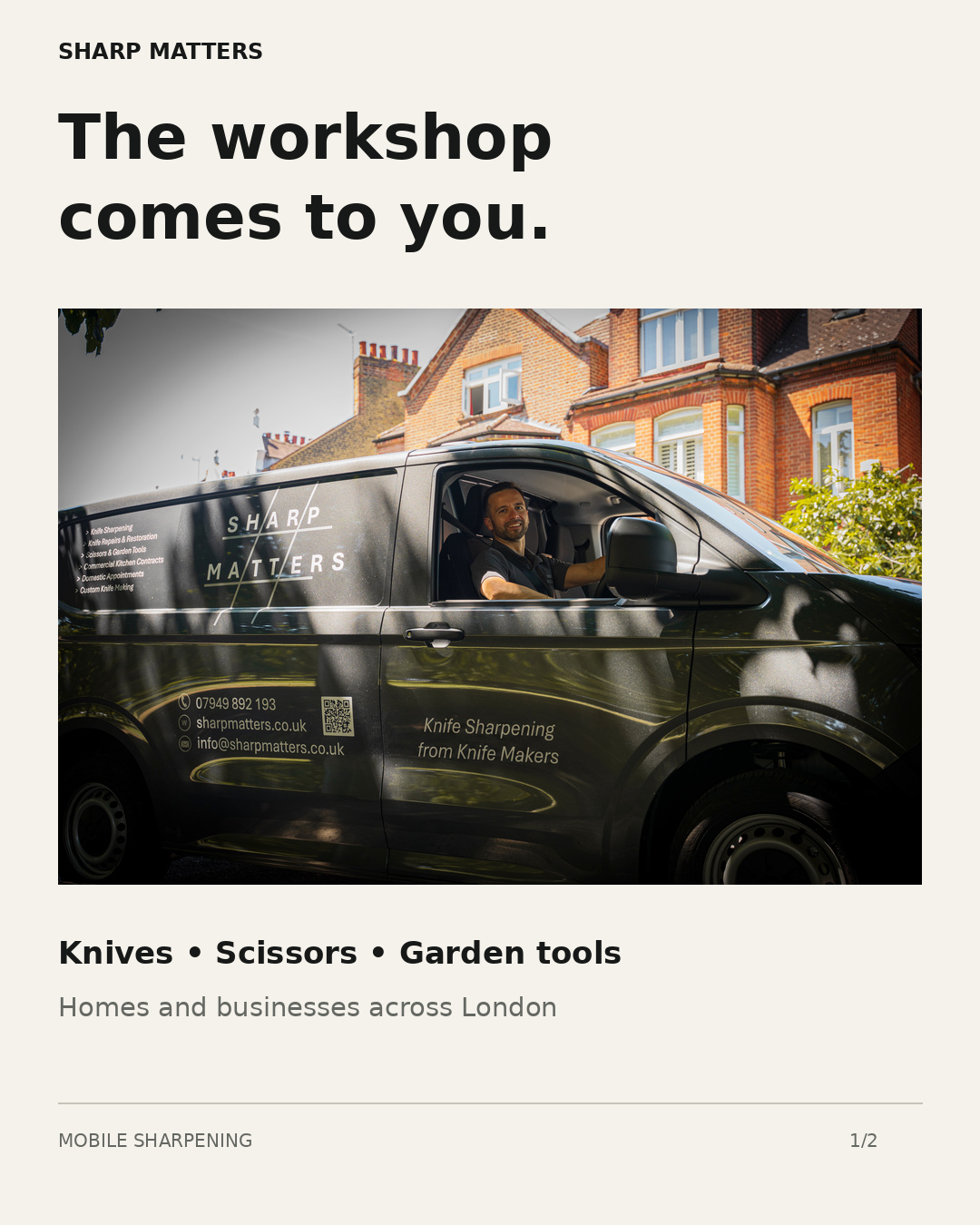
A mobile sharpening visit brings the workshop to your home or business. There is no need to take your knives to a shop: the work is assessed and carried out from the Sharp Matters van.
Here is what to send before booking, what happens at the visit and why the condition of the whole knife matters.
Before booking: photos, quantities and your postcode
Start with a photograph of the items you would like sharpened, how many there are and your postcode. For a chipped edge or broken tip, include both a close-up of the damage and a photograph of the whole knife.
The wider view matters. A close-up can show a chip, but it does not show how the damage relates to the blade’s overall shape. If the knife has a particular problem in use, mention that as well.
Sharp Matters is based in Wandsworth and works with homes and businesses across London. Your postcode helps establish whether a mobile visit is suitable. The items and their condition help establish the work required before an appointment is agreed.
At the visit: assess the work first
Before sharpening starts, I assess the items and discuss the proposed work. A knife may need straightforward sharpening, or it may have damage that calls for a repair. Not every damaged item is suitable for the same treatment.
The assessment considers the blade’s shape, condition and intended use alongside the cutting edge. My background in knife making informs that approach: the aim is a useful cutting tool that performs well for the job you use it for.
Sharpening in the mobile workshop
The van carries the sharpening equipment, so the workshop comes to you. The work is matched to the individual knife rather than treating every blade as though its shape and condition were identical.
Inspection, controlled sharpening and finishing are parts of that process. Microscope inspection can help examine an edge in detail; sharpness testing and practical cutting checks provide further information. No single image or test tells the whole story.
If the knife has chips or a broken tip, repair decisions also need to account for the remaining blade. A repair may change its outline, so it is worth discussing what can reasonably be preserved before the work goes ahead.
Getting your items back
The completed items are returned once the agreed work is finished. The time needed depends on the number of items, their condition and the work required; a damaged knife can need more attention than a routine sharpen.
If you have a particular deadline, explain it when enquiring so it can be considered before an appointment is arranged.
Can scissors or garden tools be included?
Sharp Matters also sharpens scissors and garden tools. Include photographs of these when you enquire rather than assuming that every type of tool is suitable. The same starting information is useful: the type of item, quantity, condition and your postcode.
Enquire about a mobile sharpening visit
Send photos, the number of items and your postcode on WhatsApp: 07949 892193. For a damaged knife, add a close-up and a photograph of the whole blade.
You can also read more about mobile knife sharpening in London.
For a sharpening or repair enquiry, send photos of your items, the quantity and your postcode. For a damaged knife, include a close-up and a photo of the whole blade.